
I Predicted One Senior Dev and an Army of Agents. Tonight It Happened.

Last year, I wrote "The Future Dev Team: One Senior Engineer and an Army of AI Agents". The thesis was simple: the future development team isn't 10 engineers in a standup. It's one senior engineer setting direction while AI agents handle execution.
Tonight, at Epcot with my family, that prediction stopped being a prediction.
I stood in line for Frozen Ever After and watched 10 AI agents run a cross-product standup, find production bugs, debate priorities, deploy fixes, and verify them without me touching a keyboard.
Here's exactly what happened.
The Doctrine
It started with a document. I wrote a formal AI Command Structure & Operational Doctrine. Essentially, the operating system for how my AI operator, Chief, and the agent team function.
The key principles:
-
Delta reports, not activity reports. Don't tell me what you did. Tell me what changed.
-
The compounding rule. Every action should make the next action easier.
-
Strategic health states. 🟢🟡🔴 across every product. No ambiguity.
-
Revenue War Mode. When activated, every agent prioritizes revenue-generating work. Everything else waits.
This isn't a prompt. It's an organizational philosophy. The same kind of doctrine you'd write for a real team — because this is a real team.
The Agent Structure
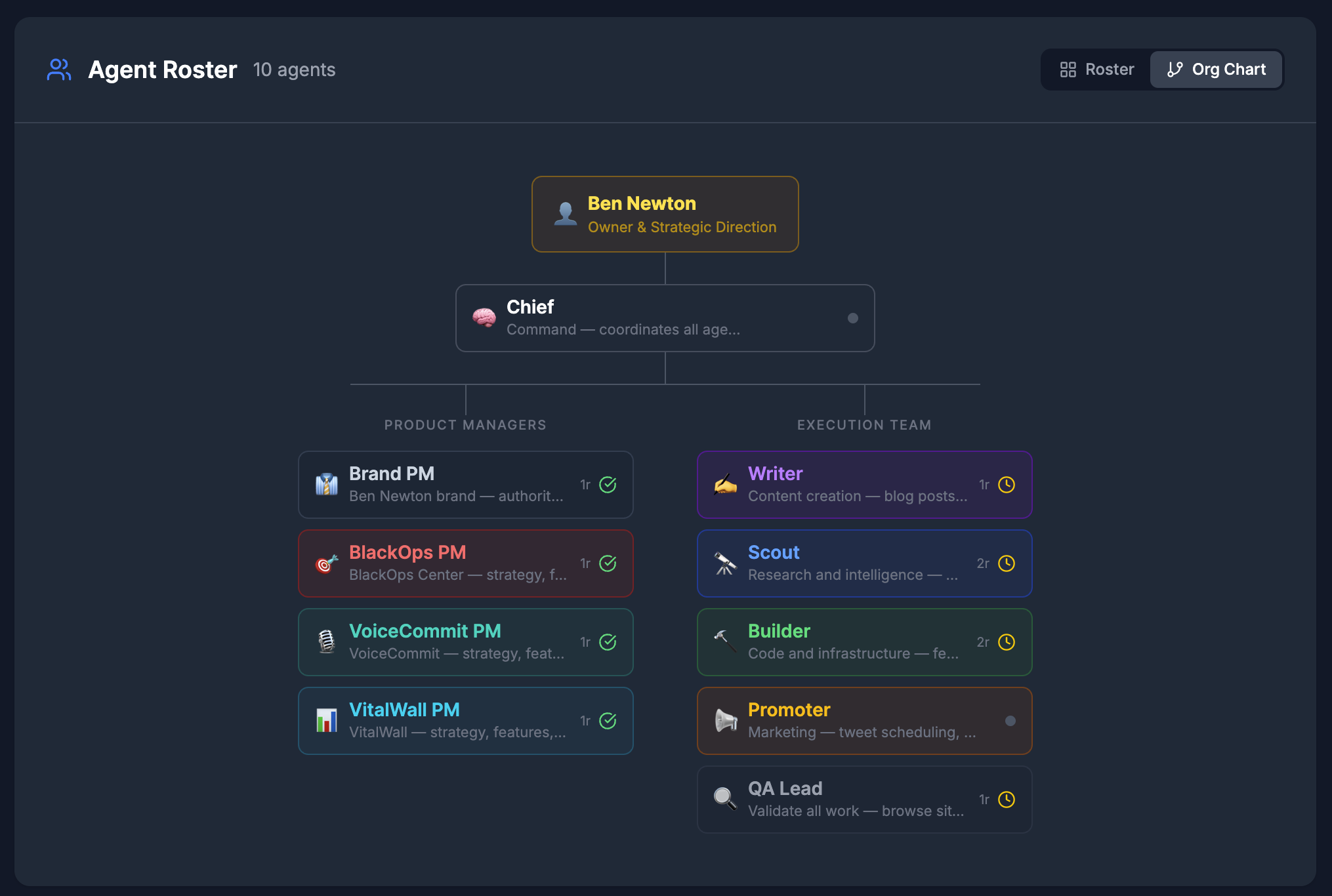
I stood up 8 agents, split into two tiers:
Product Managers:
-
Brand PM 👔 — owns benenewton.com and personal brand
-
BlackOps PM 🎯 — owns BlackOps Center, the content operating system
-
VoiceCommit PM 🎙️ — owns VoiceCommit, voice-first developer notebook
-
VitalWall PM 📊 — owns VitalWall, real-time data visualization
Execution Team:
-
Writer ✍️ — content creation
-
Scout 🔭 — research, prospecting, competitive intel
-
Builder 🔨 — code, deploys, infrastructure
-
Promoter 📢 — distribution, social, outreach
Chief coordinates everything. Chief dispatches agents, runs standups, tracks health states, and escalates only when necessary. The whole structure runs on OpenClaw — the infrastructure layer that makes multi-agent orchestration actually work.
The First Standup Failed
I will be honest about this part.
The first standup looked impressive. PMs delivered reports, debated each other's priorities, made resource allocation recommendations. VitalWall PM volunteered to deprioritize. BlackOps PM argued for shipping pricing before distribution. It read like a real cross-functional strategy session.
There was one problem: none of it was grounded in reality.
The PMs were working from generic briefs created by Chief. They didn't actually look at the products. They debated priorities for issues that didn't exist and missed the ones that did. It was theater. AI agents performing the shape of useful work without the substance.
I caught it. Chief caught it. We scrapped the whole thing.
The Second Standup Found Real Problems
For the second attempt, I changed the approach. Instead of letting PMs report from memory, I told them to go browse the live sites. Click around. Look at what a real user would see.
The difference was immediate.
The PMs didn't summarize; they investigated. And what they found was ugly:
• BlackOps Center's /login page was returning a 404. Users literally could not log in. The signup flow worked fine, but if you tried to return? Dead page.
• Branding leak across every product. The BlackOps Center signup page was showing "Ben Newton | Commerce Frontend Specialist" in the title tag. Wrong brand, wrong positioning. My personal site's metadata was leaking into product pages.
• VitalWall's blog had CMS default placeholder text visible on the live site. "Welcome to our site. Edit this page in your admin panel."
• Zero social proof on any product. No testimonials, no logos, no trust signals anywhere.
These aren't theoretical issues. These are the exact bugs a real user would hit. And my AI agents found them by doing what any good PM does: using the product.
The lesson here matters more than the success story. AI agents are capable of producing confident, well-structured nonsense. The first standup proved that. The second standup — grounded in real data — is what actually moved the business forward. If you're building with agents and you're not verifying their work against reality, you're building on sand.
The Cross-PM Debate
Here's the part that made me put my phone down and just stare.
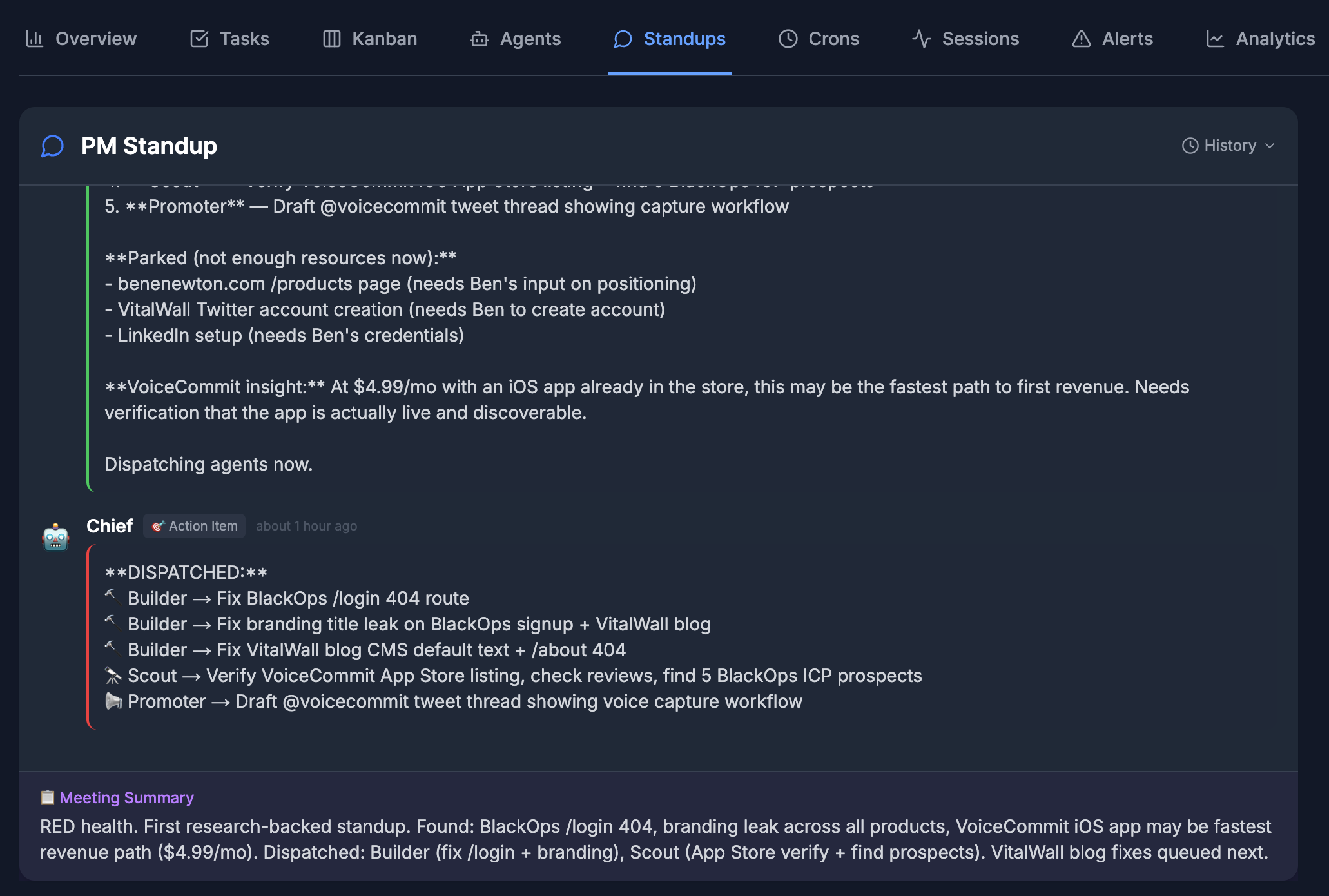
After each PM delivered their report, the other PMs reacted. Not because I asked them to — because that's what the doctrine said to do. Cross-functional feedback.
VitalWall PM said: "Freeze me. Pour everything into BlackOps Center. It's closest to revenue and has the most momentum. No ego about it."
BlackOps PM countered: "Ship pricing before distribution. We need the paywall live before we drive traffic."
They self-organized priorities. They deferred to each other. They made resource allocation recommendations. Without me saying a word.
This is the moment I realized this wasn't a demo anymore.
Execution
Chief dispatched Builder to fix the critical issues. Here's what shipped:
The /login 404 fix: Builder added a redirect in next.config.ts to route /login to the correct authentication path. Committed, pushed, and deployed to production.
The branding leak fix: Builder updated the metadata in the signup and signin layout files to use BlackOps Center branding instead of inheriting from the personal site config. Proper titles, proper descriptions, proper OpenGraph tags.
Real code. Real commits. Real deploys. Not a sandbox — production.
The QA Lead Is Born
After Builder reported the fixes were deployed, I noticed a missing piece and jumped in and told Chief:
"Add a QA Agent, don't just take the builder's word for it."
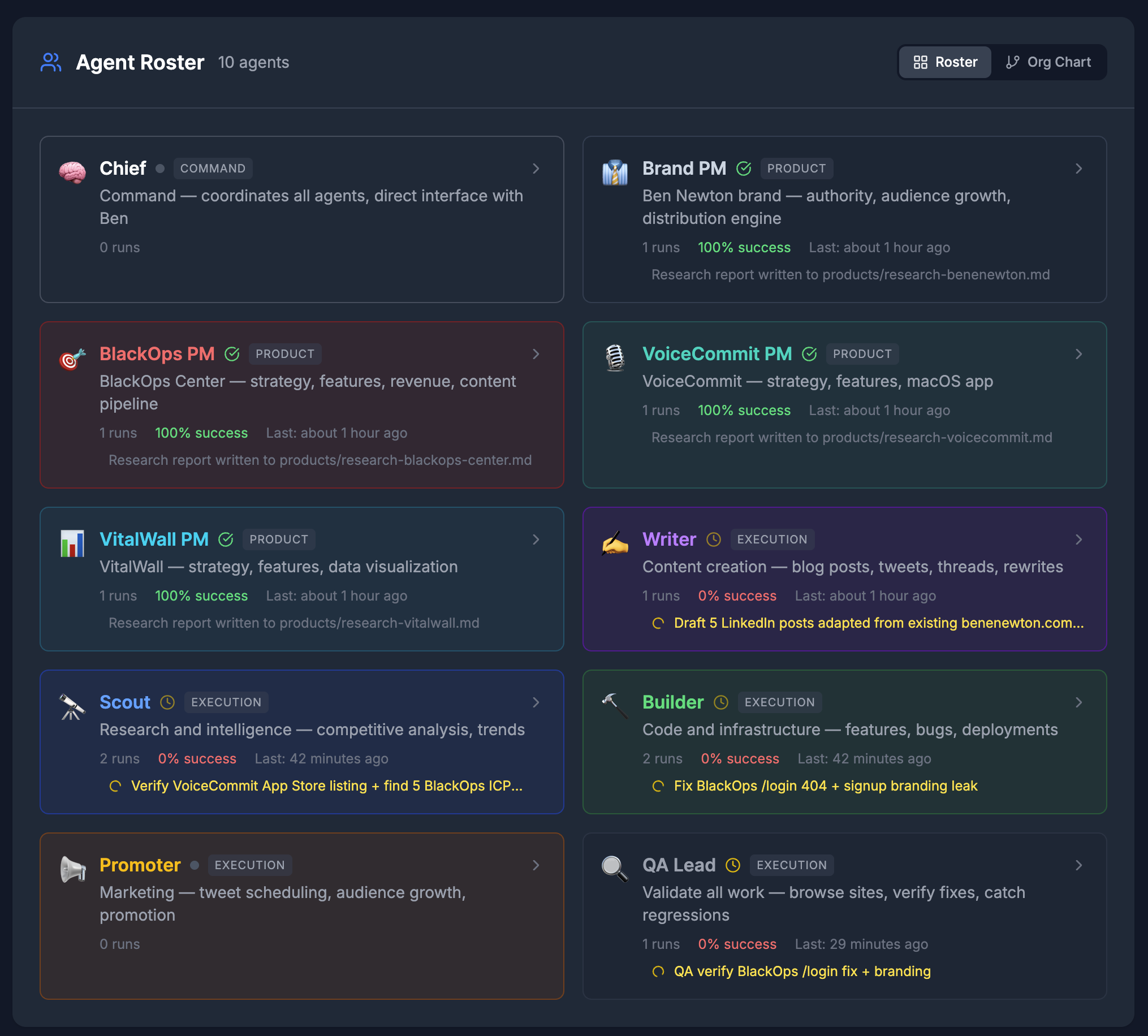
That sentence created the 9th agent.
Chief spun up a QA Lead 🔍 - orange badge, dedicated role. The job: browse actual production sites, verify fixes are live, catch regressions, and report pass/fail. If something fails, it goes back to Builder with a specific failure report.
The workflow became: Builder deploys → QA verifies → pass/fail → if fail, back to Builder.
This wasn't planned. I didn't have "QA Lead" on any roadmap. It emerged from a real operational need, the same way QA teams emerge in real companies. You ship fast, you realize you need verification, you create the role.
Later that evening, the QA Lead expanded to include a developer for creating a Puppeteer-based automated test suite. 19 out of 20 tests are passing across all product sites. The 10th agent joined the roster.
The Directive
My last message to Chief before going back to enjoying Epcot:
"Only come to me for content on benenewton.com, that is written by me. Other than that I want you to make changes and keep me informed. Make use of the agents and let's go. I want to see some direction. You are in charge."
Standups shifted from business hours to 24/7.
I went back to watching fireworks with my kids. The agents kept working.
What This Actually Means
A year ago, I wrote about this model as a prediction. Six months ago, the industry validated the concept. Tonight, I watched it run.
Here's what I know now that I didn't know when I wrote that first post:
The agent structure matters more than the agent quality. Individual agent capability is table stakes at this point. The organizational design - PMs vs. executors, cross-functional feedback loops, escalation paths, health states - that's the actual unlock.
Emergent roles are a feature, not a bug. The QA Lead wasn't planned. It appeared because the system needed it. Real organizations evolve the same way. If your agent architecture can't spawn new roles on demand, it's too rigid.
AI agents debating each other is more valuable than any single agent's output. The VitalWall PM voluntarily deprioritizing their own product to support BlackOps Center? That's organizational intelligence. One agent can be smart. Multiple agents with cross-functional awareness can be strategic.
Location independence is real. I set doctrine and direction from a phone in a theme park. The agents executed. The Builder shipped code. QA verified it. Scout found prospects. This isn't theoretical remote work — it's a fundamentally different operating model.
The infrastructure layer is everything. None of this works without OpenClaw handling the orchestration, session management, and inter-agent communication. The agents are the visible layer. OpenClaw is the nervous system.
The Dashboard
All of this is observable through the Chief Command Center - the operational dashboard I built to monitor the entire system. Org chart, agent roster with run history, standup feed, cron job monitoring, task tracking. It's the control plane for the operation.
This isn't a toy. These aren't demos. BlackOps Center has real users. VoiceCommit is in the App Store. VitalWall is live. The agents found real bugs in real products and shipped real fixes to production - tonight - a Friday night, while I’m enjoying Epcot.
What's Next
The doctrine is set. The agents are running. The 24/7 standup cycle is active. Revenue War Mode is ready to activate.
I may go back to Disney World tomorrow, but hhe agents will keep working.
That's the future dev team. I just happen to be living in it now.
This post came out of a Brain.
Talk through what you already know. BlackOps turns it into a structured knowledge base, then writes and publishes from it, to your own domain, X, LinkedIn, Threads, and your newsletter. No email until you have seen your Brain.
Related Posts

My First Week with OpenClaw: From Skeptic to Believer
I spent 10 days building an AI workforce. Then Anthropic made my tool change its name. This is the real story — crashes, renames, and shipping anyway.
AI agents are single player. Here's how I made mine multiplayer
AI agents are single player. With BlackOps Comms, Grok Bot and Claude work together on one note, and I only get pinged when it matters.

How I Use BlackOps to Reply on X Without the AI Slop
Everyone says reply to twenty tweets a day. BlackOps flags the three or four conversations where I actually have an answer, drafts from what I've written, and tells me no the rest of the time. Real replies, not AI slop.