
I Was Trying to Buy a Truck. I Accidentally Discovered the Future of Note-Taking.
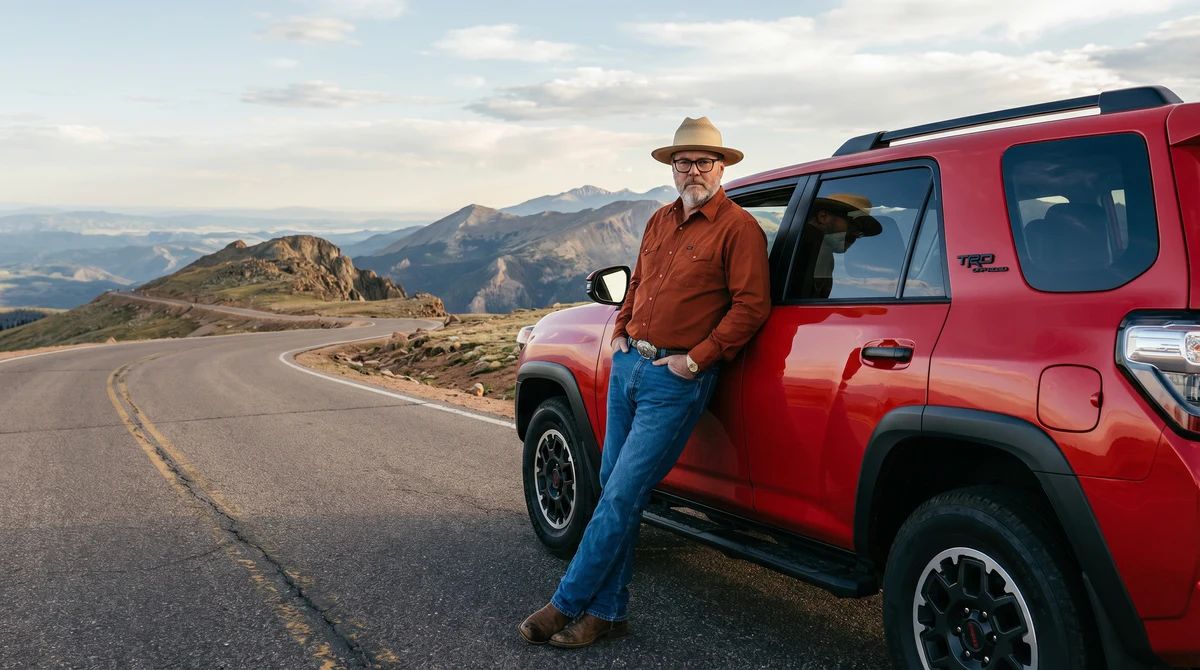
It's Sunday. My wife and I need to replace our car.
The 2018 Volvo has 130,000 miles on it. It's been good. But it's time.
We've been talking about a Toyota 4Runner TRD Off-Road for a while. Today I sat down and just started doing the research. No agenda. No content plan. Just a guy trying to figure out what it would cost to buy a truck.
I opened a conversation with Claude and started asking questions.
What's the MSRP on a 2025 TRD Off-Road Premium? What does the i-FORCE MAX hybrid add? What's the trade-in value on a 2018 Volvo S60 T5 with 130k miles? What financing rate do Chase Private Client customers get? What's in inventory near Orlando right now? Is there anything used under 10,000 miles in a color my wife will approve? (Not blue. Not gray. For the record.)
An hour later, I had real answers to all of it.
Pricing across every relevant trim. A KBB trade-in range for the Volvo. Monthly payment scenarios at three different down payment levels. The exact Chase Private Client discount and how to stack it against Toyota Financial promotions. Dealer names, phone numbers, and VINs on specific units within 15 miles. A list of four used trucks I'd investigated and why each one was the wrong trim or the wrong color. A ranked shortlist of what to actually go look at.
Real research. The kind that usually ends up scattered across 12 browser tabs, a half-used Notes app, and your own memory.
Then I noticed something.
I hadn't written down a single thing.
The Moment
At the end of the session I said, out loud, something I hadn't planned: "We should log all of this to BlackOps."
And then I just did it.
One instruction. Claude structured the entire session into a clean Markdown note and committed it directly to my Obsidian vault via BlackOps and GitHub. Every detail was there: trade-in values, payment scenarios, dealer contacts, VINs, ruled-out options, next actions, and even the content angles I could write about later.
Here's a slice of what it captured automatically:
Trade-In: 2018 Volvo S60 T5
KBB Trade-In Value: $8,050 to $9,575 (dealer offer, condition-dependent)
KBB Private Party: $11,130 to $13,180
Action: Get Carvana/CarMax offer first as floor before dealer negotiation
Financing: Chase Private Client
0.25% rate discount when financing online through Chase Auto
Must purchase from a Chase partner dealership. Verify Toyota dealer is in network.
Locks rate for 30 days after prequalification.
That's not a summary. That's not AI-generated filler. That's my actual research, structured, saved, and ready to pick up the moment I walk into a dealership.
No copy-paste. No tab switching. No "wait, where did I see that number."
What I Actually Built
I built BlackOps to be an authority engine for content creators. A system for people who have real knowledge and real experience and want to publish it without the friction of starting from scratch every time.
The pitch has always been: your knowledge shouldn't live only in your head. It should live in a system that helps you deploy it.
But today, using my own product as a regular person trying to make a $60,000 purchase decision, I found something I hadn't explicitly designed.
The conversation is the research.
When you're talking through a problem with AI, the knowledge isn't disappearing. It's accumulating. Every answer builds on the last one. By the end of an hour-long session you haven't just gotten information. You've done structured, sequential research across a complex topic with multiple decision variables.
The problem has always been retrieval. That research lives in a chat window. It's ephemeral. You close the tab and half of it evaporates.
BlackOps solves the retrieval problem. Not by summarizing. Not by extracting highlights. By treating the conversation as a knowledge artifact and committing it to a permanent, structured, searchable system. In my case, Obsidian via GitHub. But the destination doesn't matter as much as the behavior.
I never have to take notes again.
Not because I'm lazier. Because the research process itself now generates the notes. The act of asking good questions, getting good answers, and then saying "log that" is the entire workflow.
Why This Matters Beyond Me
I've been thinking about BlackOps as a tool for content professionals. CTOs. Founders. Consultants. People who need to publish expertise at scale.
But this truck research session made me realize the use case is broader than content.
Any time you have a complex, multi-variable decision, you're doing research. Buying a car. Hiring someone. Evaluating a software vendor. Planning a project. Preparing for a negotiation. In every one of those scenarios, you're accumulating knowledge through conversation, and that knowledge has historically been almost entirely lost.
BlackOps captures it. Structures it. Makes it retrievable and buildable.
That's not a content tool. That's a knowledge infrastructure tool. And the content is what happens when you deploy that knowledge in public.
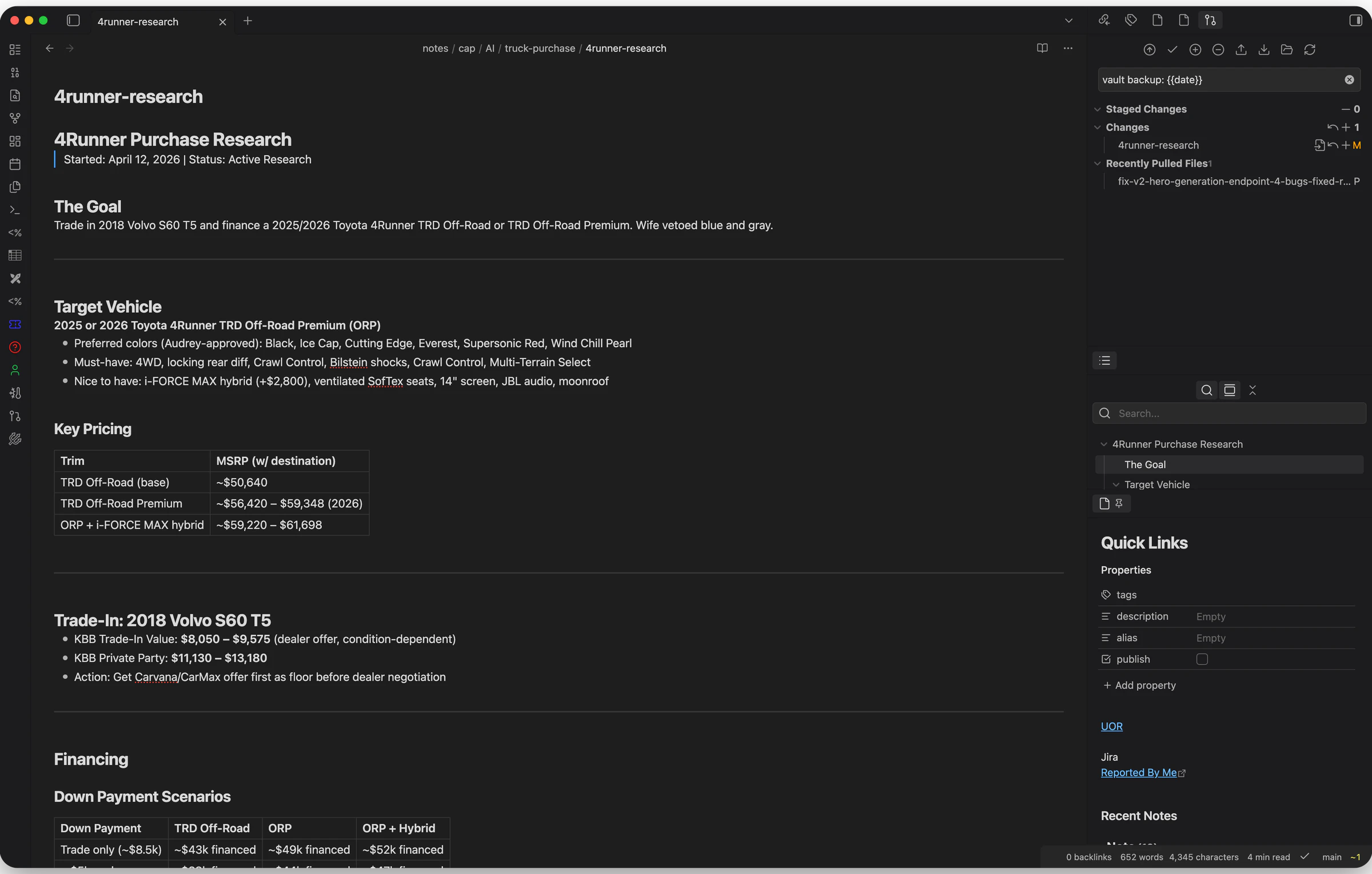
Screenshot of generated Obsidian Note showing all our research for the new truck.
What Comes Next
I still don't have the truck. That's the next session.
I'll pull up the note, pick up where I left off, call AutoNation Winter Park about incoming ORP inventory in Cutting Edge or Supersonic Red, get the Carvana appraisal on the Volvo, and run the Chase prequalification. Everything I need is already in the note, organized and linked.
When I close the deal, that session gets logged too. And at the end of the process I'll have a complete, structured record of how a $60,000 decision was researched, evaluated, and made.
That record is also a story worth publishing. Which is how the whole thing pays for itself.
The future of note-taking is not typing faster. It's not better templates or prettier apps or smarter OCR.
It's having a conversation, doing real work, and then saying: "log that."
BlackOps does the rest.
Want to follow how this plays out? I'm building in public. Subscribe below for weekly updates from inside the build.
This post came out of a Brain.
Talk through what you already know. BlackOps turns it into a structured knowledge base, then writes and publishes from it, to your own domain, X, LinkedIn, Threads, and your newsletter. No email until you have seen your Brain.
I wrote this post inside BlackOps, my content operating system for thinking, drafting, and refining ideas — with AI assistance.
If you want the behind-the-scenes updates and weekly insights, subscribe to the newsletter.
Related Posts

Einstein Didn't Remember the Speed of Light
Einstein famously said he didn't bother remembering things he could look up. Thirty years into this career, I think I finally understand what he meant.

I never remember to send my newsletter, so BlackOps sends it now
My last newsletter went out August 19. So I built Newsletter Autopilot: if I miss my deadline, BlackOps writes the issue from what I published and tells you it's covering for me.
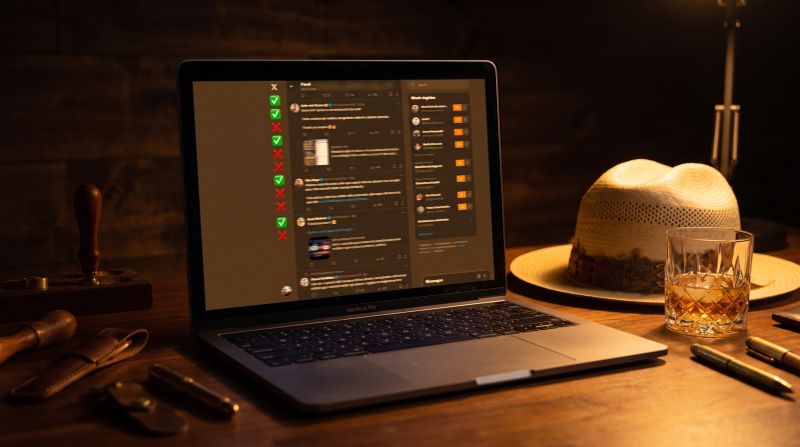
Jev now makes the decisions in BlackOps that I used to hand to an LLM
Jev returns typed decisions, not prose. In BlackOps it scores reply targets, checks brand voice on publish, filters feeds and reads task replies.