
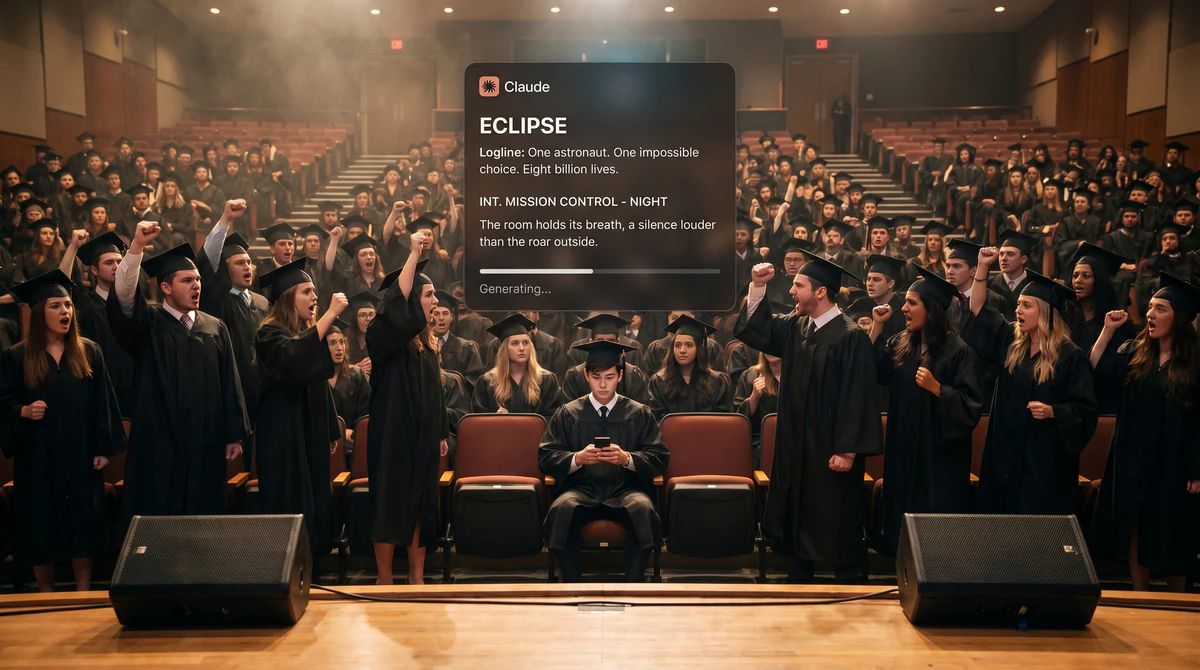
Last week at UCF's commencement ceremony for the College of Arts and Humanities, a speaker named Gloria Caulfield told a room full of graduating writers, journalists, designers, and media students that AI is "the next industrial revolution."
The room erupted in boos. Someone yelled "AI sucks." Caulfield stood there visibly stunned, asking "what happened?"
I get it. I genuinely do.
Who was actually in that room
This wasn't a general graduation. This was specifically UCF's College of Arts and Humanities and the Nicholson School of Communication and Media. Journalism. Creative writing. Film and television production. Advertising. Digital media. Public relations.
These are people who spent four years and serious money training to write, produce, shoot, and publish. And the tools they trained on are being replaced, automated, or devalued in real time. The floor on junior creative work is collapsing. That's not paranoia. That's what's happening.
Their anger is legitimate.
Their response is the problem.
Every wave does this
Photography didn't kill painting. It killed portrait painters who refused to evolve. The ones who adapted became fine art photographers, photojournalists, and graphic designers. A new floor dropped out. A new ceiling appeared for someone else.
The internet didn't kill journalism. It killed the business model that paid reporters to rewrite press releases. The reporters who figured out how to build direct audiences became more valuable than anyone at a legacy outlet.
The pattern is the same every time. Technology bifurcates the room. Adapters move up. Resisters get displaced. The displacement isn't because the technology is evil. It's because someone else learned to use it and they didn't.
The honest part
Here's what I won't paper over: the entry-level pipeline for creative work is genuinely compressing. Junior copywriter. Junior motion graphics. Entry-level video editor. Those jobs are getting harder to find, and AI is part of why. It's fair to be angry about that.
But there's a ceiling forming above all of it that barely anyone is talking about.
The VFX artist who learns to art-direct AI generation, control it, QA it for continuity and style, is exponentially more productive than the one doing it frame by frame. The writer who knows how to train a system on their voice and use it to go from idea to published piece in an hour isn't being replaced. They're removing everyone else from the competition.
The person who becomes the expert in making AI output not look like AI output? Irreplaceable for a decade minimum.
Taste. Judgment. Domain credibility. Those cannot be prompted.
You still need someone in the room who knows when it's wrong.
The thing people get backwards about AI and writing
The fear is that AI writes instead of you. That you hand it a sentence and it hands back a book and somehow that's your work now.
Nobody is making you do that.
You can direct it. You can train it on your voice, your thinking, your body of work. You can use it to go from rough idea to structured draft in the time it used to take to open a blank document. It's still your voice. It's still your thoughts. It's still your judgment deciding what stays and what gets cut.
That's not replacement. That's velocity.
The writer who figures that out doesn't produce more generic content. They produce more of their own content, faster, with less of the mechanical overhead that was killing momentum anyway.
The BlackOps version of this
This is the whole thesis behind why I built BlackOps.
AI doesn't replace the person with 30 years of hard-won judgment. It removes everyone else from the conversation.
The system I run trains on my content, learns my voice, and lets me run a full publishing operation across a blog, X, and LinkedIn without a team. Not because I handed it a prompt and walked away. Because I spent years building the perspective that makes the content worth reading. The AI handles production speed. I handle everything that requires actually knowing something.
That's the formula. The creative graduates in that room have something most AI operators don't: real domain knowledge, real taste, and the ability to recognize when the output is wrong.
That's not a liability in the AI era. That's the only thing that matters.
Figure out how to use the tool. Keep the judgment. That combination is the job.
💌 Want more insights like this?
Subscribe to my newsletter for weekly deep dives into frontend development, AI, and productivity.
Related Posts

I never remember to send my newsletter, so BlackOps sends it now
My last newsletter went out August 19. So I built Newsletter Autopilot: if I miss my deadline, BlackOps writes the issue from what I published and tells you it's covering for me.

Jev now makes the decisions in BlackOps that I used to hand to an LLM
Jev returns typed decisions, not prose. In BlackOps it scores reply targets, checks brand voice on publish, filters feeds and reads task replies.

I did not want another writing tool
Every AI writing tool opens with a blank box and asks what you want to write about. Then the model invents something, and it reads like it was written by someone who has never done the work. The gap worth closing is not writing. It is the hour between knowing something and having published it.