
BlackOps Center: The Accidental Product That Became My Next Chapter
What started as a blog rewrite became the foundation for everything I create now.
Every couple of years, I rebuild my blog. It’s not a strategic move or part of some grand plan—it’s more like a personal reset button. I pick a new framework I want to learn (or need to learn), tear everything down, and start fresh. It keeps me sharp, clears my head, and honestly, it’s just fun. I’ve been doing it for as long as I can remember.
So when Cursor showed up, I treated it like the next round of that ritual. I decided to rebuild the site from scratch, kick the tires on this new AI-assisted workflow everyone was buzzing about, and then move on. In those early months of the AI coding boom, Cursor wasn’t anywhere close to what it is today. It made mistakes, it skipped steps, and half the features we take for granted now didn’t exist yet. But even with all that, it was still faster than doing everything manually. More importantly, you could feel something shifting—week after week, the tools were noticeably improving. It was the first real hint that coding was about to change in a major way.
I didn’t realize it then, but that was the first domino in a much longer chain.
Where Things Actually Changed
Around the same time, Claude became my default model, and I immediately started building small database-driven tools with it—projects that would’ve taken me ages without AI. The experience was so smooth that one night, almost without thinking, I pointed at the pile of Markdown files powering my blog and typed out a prompt to migrate everything to Postgres.
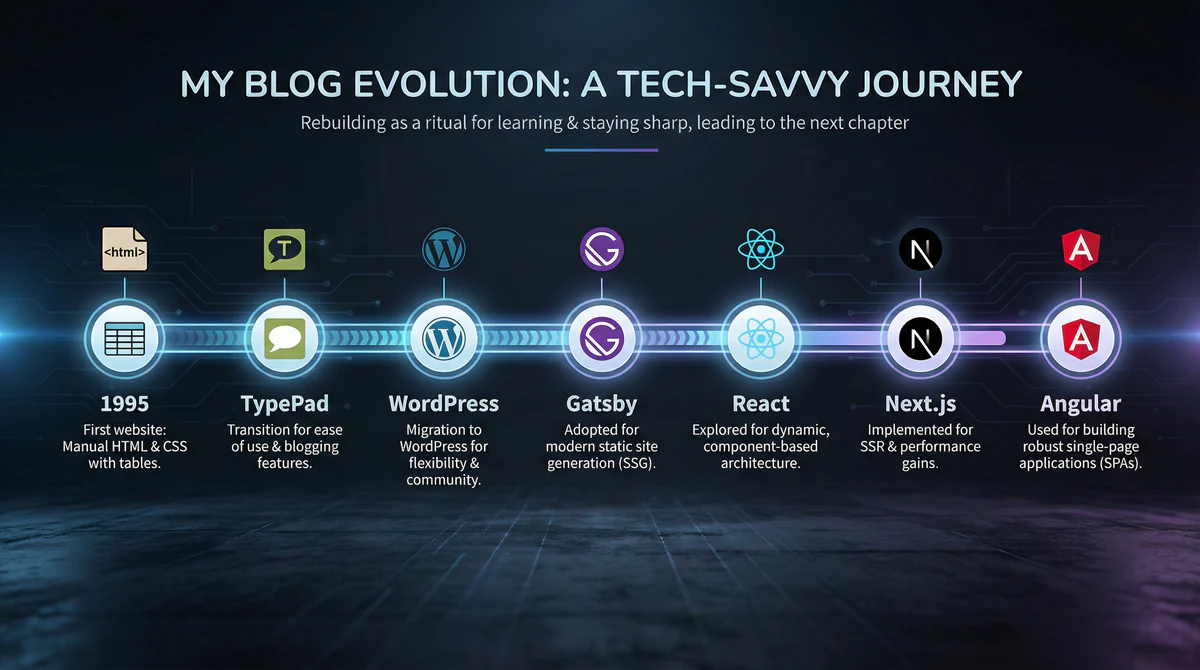
Approximate Timeline of my blog platform evolution.
That single decision opened the door to everything that followed.
The migration itself wasn’t the interesting part. The interesting part was what changed afterward. Once the blog lived in a database, I saw my entire content workflow differently. I wasn’t struggling to write—I was drowning in idea management. My thoughts were scattered across multiple notes apps, repos, Twitter drafts, voice memos, and the gravitational field that swallows all creativity: Apple Notes. I’d have a fully formed idea and then lose it because my job buried me in meetings for a week.
It wasn’t a content problem.
It wasn’t a writing problem.
It was a “my brain is spread across 14 apps” problem.
That was the moment the project quietly stopped being a blog rebuild and began to become something else.
Superpowers I Didn’t Expect
As Claude improved, it let me build at a pace I hadn’t felt in years. I’d think of a feature, outline it, and by the end of the night, I had something fully functional—not a prototype, not a hacked-together experiment, but a complete, tested feature I could immediately fold into my workflow.
It felt like leading a team of developers who could time-travel. I could get a sprint’s worth of work finished in a single evening.
For the first time in a long time, I was excited about building again. I was “in the zone” the way I used to be when I was younger—those late-night stretches where ideas flow and you lose track of time. Except now, I wasn’t staying up all night. The tools were just that fast. And because they were fast, my ideas got bigger. “What if it could do this?” “Could I automate that?” “This is probably impossible, but what if…?”
These weren’t features I would’ve attempted a few years ago. I wouldn’t have had the hours. But with agent-driven development, entire feature sets were showing up almost overnight.
The app shifted from a basic content manager into something more the moment I added the editor chat feature. Being able to highlight a section of writing and have a conversation about it with the system—fix it, rewrite it, expand it, tighten it, or simply ask “why doesn’t this feel right?”—was something I wasn’t entirely sure was possible. But a few nights later, it existed. I could highlight text in a post and have an AI collaborator help me shape it.
That’s when I realized I had crossed into new territory. This wasn’t a tool anymore. It wasn’t even a platform.
It was a collaborator.
It Grew Because I Used It, Not Because I Planned It
BlackOps never started with a roadmap. The name came from a random conversation with ChatGPT about whether this should become an app other people could use. Everything grew organically because I kept needing “just one more feature.” Every night, I built something, tested it, and then immediately used it to create something else - blogs for my other apps, content for upcoming launches, meeting notes I didn’t want to lose, posts for social media.
Without meaning to, it became the backbone of everything I was creating.
Of course, I kept delaying the launch. “One more feature” turned into a running joke. I told myself I’d launch it when it felt ready, but meanwhile, I was the only one using a tool that had clearly outgrown its original purpose.
Asking the agent to replace selected text for the header above in Black Ops Center post editor.
The Moment It Clicked
One night, after shipping yet another feature that would’ve required a small team a decade ago, I leaned back and said out loud—to an empty room—“This is my next chapter.” And the moment I said it, I knew it was true.
BlackOps wasn’t just another side project. It wasn’t another “rebuild my blog” season. It wasn’t another “learn a new framework” experiment. It was a real product. A powerful one. One that could actually help people who were dealing with the same scattered chaos of ideas and half-finished drafts that I had been fighting for years.
And the bigger realization? This is exactly the kind of platform Squarespace and WordPress will scramble to retrofit with AI in the coming years, but it will never feel native to them. They weren’t born in this era. BlackOps was.
This is the first platform I’ve built that could genuinely stand on its own. And I’m finally at a point in my career where I’m ready for that.
Why I’m Launching It Now
Because I’m ready.
Because the app is ready.
And because waiting doesn’t add anything anymore.
BlackOps already changed how I work. It made me prolific again. It helped me finish ideas instead of letting them die in a notes app. It made writing fun again - something I honestly haven’t said in years. It kept ideas from slipping away. It took “I wish I had time” and turned it into “I can finish this tonight.”
I built it for myself. I’m launching it because there are a lot of people like me who need it just as badly.
What I Want You to Feel When You Use It
Relief.
Relief from finally having a system that keeps up with your brain instead of slowing it down. Relief from having a place where ideas don’t get lost. Relief from the endless rewriting, polishing, reorganizing, and formatting that eats all your time. Relief from the heavy parts of creating.
If BlackOps gives you even a fraction of the clarity and momentum it gave me, then it’s doing its job.
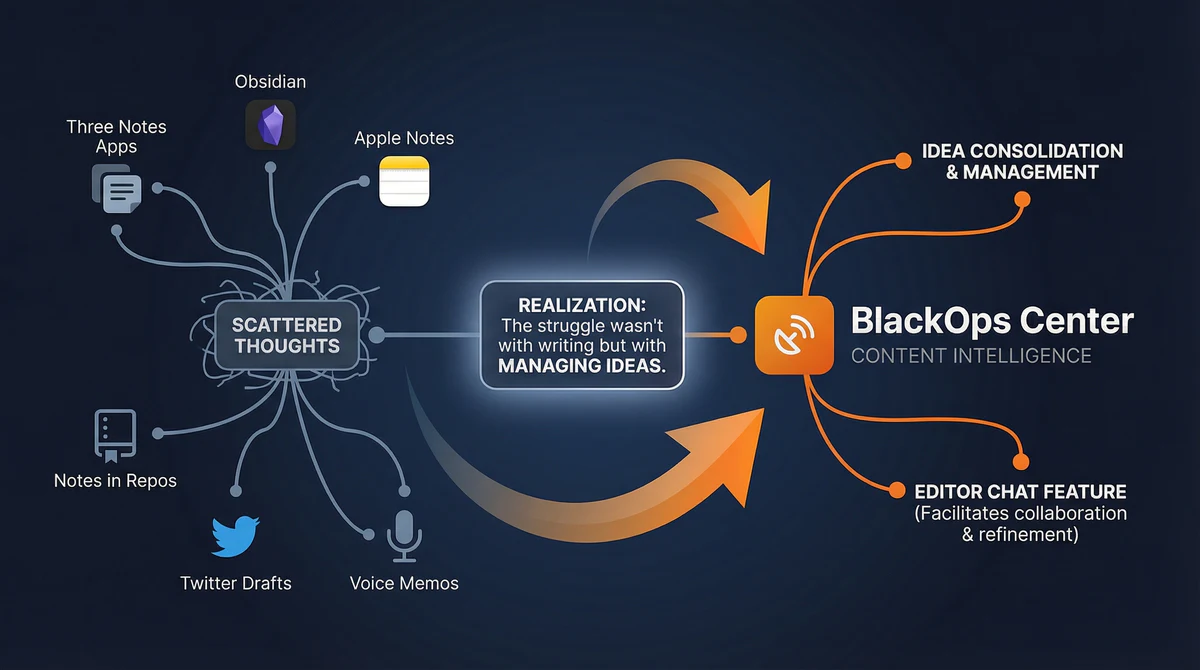
Before Black Ops, my thoughts were scattered across apps.
Where This Goes Next
BlackOps started as an experiment. Now it’s the foundation for what I want to build for the rest of my career. I’ve been wanting to launch products for years, and this one surprised me by becoming the first that felt too important to keep to myself. I thought my other apps would come first, but this is the one that grew naturally out of real use, real pain, and real momentum.
And now I’m ready to support others using it. I’m ready to see where it goes. I’m ready for what comes next.
If you want to be part of the beginning of that chapter:
https://blackopscenter.com/start
This is only the start. And honestly, I haven’t been this excited in a very long time.
This post came out of a Brain.
Talk through what you already know. BlackOps turns it into a structured knowledge base, then writes and publishes from it, to your own domain, X, LinkedIn, Threads, and your newsletter. No email until you have seen your Brain.
I wrote this post inside BlackOps, my content operating system for thinking, drafting, and refining ideas — with AI assistance.
If you want the behind-the-scenes updates and weekly insights, subscribe to the newsletter.
Related Posts
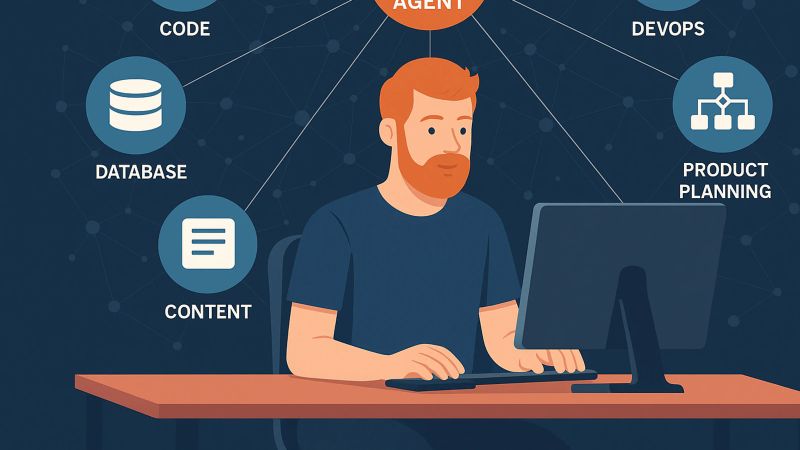
How I Created Mission-Command Development (The Backstory)
How a single senior developer with AI agents can replace entire development teams, transforming software delivery from slow team coordination to rapid mission command execution.

I did not want another writing tool
Every AI writing tool opens with a blank box and asks what you want to write about. Then the model invents something, and it reads like it was written by someone who has never done the work. The gap worth closing is not writing. It is the hour between knowing something and having published it.

Claude's Watermark Has a Shelf Life
Anthropic now watermarks Claude's text output worldwide. The mark works. It will also stop meaning anything, because assistance is on its way to being universal and a signal present on everything distinguishes nothing.