
Stop Hiring Cooks. Start Building Kitchens.
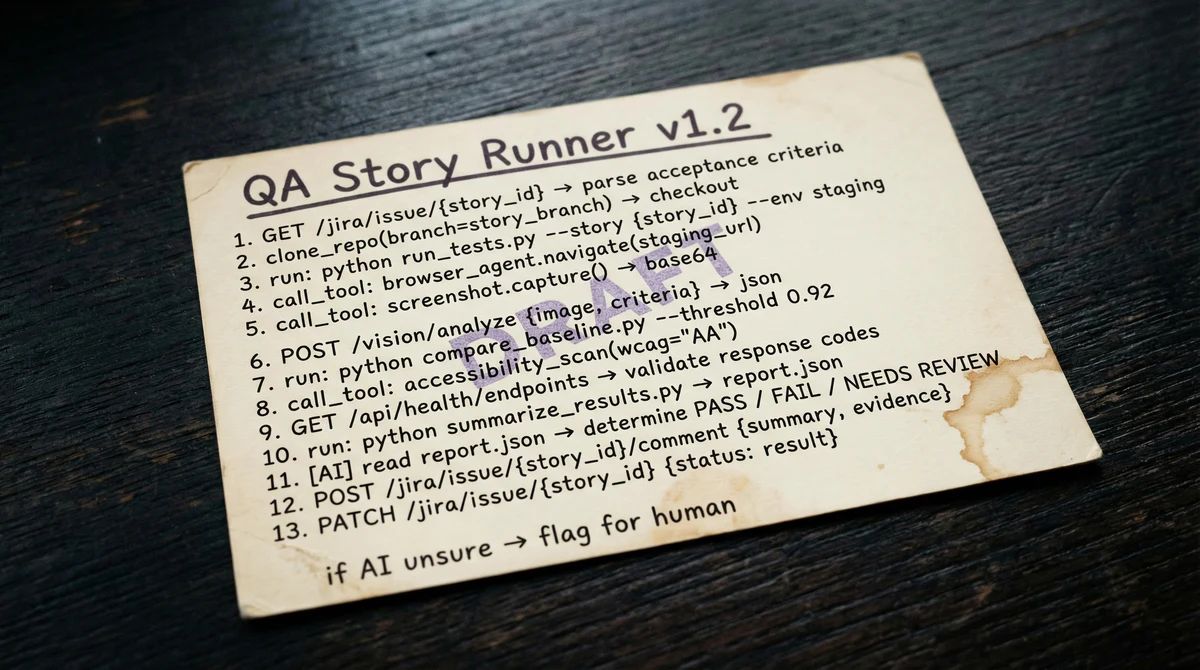
There's a phrase that's been spreading through meetings and Slack channels and executive decks for the last two years.
We can use AI for that.
And technically, that's often true.
You can hand AI a problem it has never seen before, give it no structure, no tools, no context, and it will figure something out. It might even be impressive the first time.
But if your plan is to do that reliably, repeatedly, and at scale, you don't have a solution. You have a demo.
The Cook Without a Kitchen
Imagine you ask a talented cook to make a dish they've never prepared before.
No warning. No prep time. No mise en place.
They'd have to figure out the ingredients, look up a recipe, improvise what they can't find, and cook it for the first time while hoping it comes out right.
Maybe it does. Maybe it's actually great.
But can you replicate it tomorrow? Can you put it on a menu? Can you serve it to a hundred people on a Friday night?
Now imagine a restaurant that specializes in that exact dish.
The kitchen is set up for it. The ingredients are always stocked. The chefs know the recipe cold. Every plate that goes out looks and tastes the same, because the system was built around that specific outcome.
That's the difference between using AI and deploying AI.
The Prototype Trap
Here's where teams consistently get stuck.
AI solves the problem. Someone runs a prompt, gets a good result, shows it in a meeting. Stakeholders are impressed. The decision gets made: we'll use AI for this.
What nobody asks is whether anyone wrote down the recipe.
One-off experiments are valuable. Prototypes should happen. There is nothing wrong with testing AI on a problem to see if it's tractable. And there's nothing wrong with serving that one-off meal.
But a prototype without documentation is a dead end. A process that worked once in a demo environment is not a process. It's a memory.
If you want to automate it, repeat it, or hand it off to another system, you need to build the kitchen first.
The Problem With Probabilistic Pipelines
If you've spent any time thinking in pure functions, this is going to resonate.
A pure function is simple: same input, same output, every time. No hidden state. No side effects. Predictable, testable, composable.
Raw AI is the opposite of that.
Same prompt does not guarantee the same output. The model version matters. The temperature matters. The context window matters. What you sent two calls ago matters. There is invisible state everywhere, and most of it is outside your control.
Developers who think in pure functions have already internalized why this is a problem. You can't unit test vibes. You can't compose probabilities reliably. You can't build a system on top of something that behaves differently every time it runs.
The goal isn't to avoid AI. The goal is to wrap the non-deterministic core in a deterministic shell.
Your tools handle the known parts: data retrieval, formatting, routing, validation, logging. AI handles what genuinely requires reasoning. And you shrink AI's surface area to the irreducible creative core, with hard walls around everything else.
The Costs Nobody Calculates
When teams evaluate whether to build proper tooling versus just prompting AI directly, they almost always compare the wrong things.
They weigh the cost of building a tool against the convenience of a raw prompt chain.
What they don't factor in:
Retries when the output format breaks. Validation failures that corrupt downstream data. The engineer hours spent debugging why something that worked last Tuesday is producing different results today. The context tokens you're burning re-explaining the same process from scratch on every single call.
And then there's prompt rot.
Raw AI pipelines degrade silently. Model updates shift behavior. Context window changes alter outputs. Nobody notices until something downstream breaks and the trail leads back to a prompt that used to work fine.
A well-built tool with AI inside it is resilient to this. A raw prompt chain is a house of cards.
The Restaurant You Have to Build
The restaurant metaphor goes deeper than it looks.
Your menu is your defined set of operations. What the system will and won't do. Your mise en place is your data pipeline, everything staged and ready before AI ever touches it. Your validation layer is the health inspector. Your orchestration is the POS system routing orders to the right station.
Great restaurants don't improvise every order. They constrain choices to what they can execute with excellence, every single time.
That's what building for AI reliability actually looks like.
This Is Where Developers Live Now
There's a divide opening up.
On one side: developers who understand that AI reliability requires infrastructure. Who are building the kitchens. The tools, the pipelines, the validation layers, the orchestration systems that make AI repeatable.
On the other side: developers who are still wondering why their prompts don't work in production.
The good news is you can use AI to build the tools. That's not a contradiction. That's just smart. Use the cook to design the kitchen. Then staff it properly.
But the work of building systems that AI can reliably operate inside? That's engineering. That's going to be the job for the next several years.
And the developers who figure that out early are going to be worth a lot.
I wrote this post inside BlackOps, my content operating system for thinking, drafting, and refining ideas — with AI assistance.
If you want the behind-the-scenes updates and weekly insights, subscribe to the newsletter.
Related Posts
AI Isn’t Replacing Developers. It’s Shrinking the Team.
AI Isn’t Replacing Developers. It’s Replacing the Space Between Them.

Command-Driven Development Logging with Visual Progress: A Better Way to Track Development with Claude Code
How I created and use a command-driven system in my everyday commerce development process with Claude Code to document progress with visual screenshots - giving me complete control over when and how enterprise development gets documented.

I never remember to send my newsletter, so BlackOps sends it now
My last newsletter went out August 19. So I built Newsletter Autopilot: if I miss my deadline, BlackOps writes the issue from what I published and tells you it's covering for me.